
Scraped SaaS: stopping a copycat from arbitraging a free tier
How a subscription search product used Prosopo to stop a competitor scraping its results through the free tier and reselling them as a copycat service.


- Customer
- A subscription search product. Free to try, paid to use properly.
- Problem
- A competitor consuming the free-tier API at scale and reselling the results as a copycat service.
- Copycat scraping stopped at the API
- Detection that does not depend on request rate
- Patterns promoted into standing rules automatically
- 7.8M sessions scored in 30 days
This customer runs a subscription search product. Search is free to try and paid to use properly, the standard model for this kind of business: the free tier is how people discover whether the product works for them.
That model has a specific failure mode. If somebody automates the free tier at scale, they are not a heavy user. They are a competitor whose cost of goods is your marketing budget.
The problem
A competing service was scraping this customer's results and presenting them as its own product. The scrape ran against the API rather than the web form, as it normally does. There is no reason to automate a form when the endpoint behind it is available.
Subscription founders report this attack more than any other, and it rarely appears as a security incident. It appears as a conversion problem, a bandwidth bill, or a competitor whose results look familiar.
What we did
The first job was separating automated search sessions from real ones. That is where most tools stop. A scraper running one search every few seconds from a residential IP does not look unusual on volume alone.
What separated them was an environment that did not hold together. The client's worker thread and main thread reported different environments, and the processor characteristics it reported did not match the rest of the session. Neither is something a scraper can avoid by slowing down.
Once the pattern was established, the anomaly detectors promoted it into standing Access Rules on the ASN and IP ranges the traffic came from. Those rules block on a cheap comparison at the edge and carry an expiry, so they follow the attacker without accumulating stale entries.
Behavioural collection on the client side did the rest of the work on sessions that came through a browser. Real people searching behave differently from a harvester: they hesitate, they scroll results, they refine.
Why the rules matter as much as the detection
The detectors identify the automation. The rules are what makes stopping it cheap: once a pattern is established, an ASN or IP-range rule rejects matching traffic on a comparison at the edge, rather than running the full scoring path on every request from a source already known to be bad.
When the operator moved infrastructure, the ASN rules followed, because the detectors kept generating them from what they were seeing.
Results
1 September 2026
The blocked share is the lowest of the three deployments in these case studies, and that is the correct outcome. A consumer search product is mostly real people. The job is not to block a large fraction of traffic, it is to find the automated fraction inside it without taxing everybody else: of the 7.5 million sessions that were not blocked, 79% were cleared by proof of work and never saw a puzzle.
Top named block reasons
30 daysNamed reasons only, with related network-origin reasons grouped into one row. A further share of blocks carry a triggered detector rather than a reason string.
The bottom half of that list is the part that matters against a copycat. A scraper running slowly from residential addresses will not trip a rate limit, and it will not appear in the top two rows until it has already been caught once. What catches it the first time is the client contradicting itself: network behaviour that does not match the operating system it claims, processor speed that does not match the device it claims, a click pattern produced by a script rather than a hand. None of those depend on how fast the requests arrive.
What we would tell a founder in the same position
Look at your API before you look at your forms. If your product has a free tier and a public endpoint, the endpoint is where the abuse is.
Then ask your current vendor what a block tells you. If the answer is a score, you will be able to see that something was stopped and not what it was, so the next attack is harder to recognise than it needs to be.
Related
Is your free tier funding a competitor?
If you run a subscription product with a free tier and you think somebody is reselling your results, tell us the URL. We will look at the traffic pattern before we reply.
Frequently Asked Questions
What problem was this customer solving?
A competitor was scraping their search results through the free tier and reselling them as a copycat product. The free tier is the acquisition channel for a subscription business, so an automated client consuming it at scale converts a marketing cost into a competitor's cost of goods.
How do you stop a scraper that looks like a normal user?
By looking at what the client cannot keep consistent. The automated client reported an environment that did not hold together: the worker thread and the main thread disagreed, and the reported processor characteristics did not match the rest of the session. Those are properties of a scripted or patched browser rather than of request volume, so they hold against a scraper deliberately running slowly. Enforcement was then a standing Access Rule on the ASN and IP ranges the traffic came from, generated automatically by the anomaly detectors once the pattern was established.
Why is a CAPTCHA on the search form not enough?
Because the scraper does not use the form. It calls the API the form calls. Protecting a subscription product against copycat scraping means scoring every request to the API, not adding a challenge to the page a human sees.
Why does free-tier scraping rarely look like a security incident?
Because nothing breaks. There is no outage, no data breach and no fraud alert. It shows up as a conversion problem, a bandwidth bill, or a competitor whose results look familiar, so it is often found late.
Related Posts to Scraped SaaS: stopping a copycat from arbitraging a free tier
Procaptcha vs Friendly Captcha - Why Real Bot Protection Matters in 2026
Wed, 13 Aug 2025
Procaptcha vs hCaptcha 2026: Pricing, Free Limit & GDPR
Wed, 13 Aug 2025
Best CAPTCHA 2026: 7 Top Solutions Compared
Thu, 11 Jun 2026

Forrester Wave Bot and Agent Trust Management Q2 2026: How Prosopo Compares
Thu, 25 Jun 2026
hCaptcha vs Cloudflare Turnstile 2026: Which Wins (and When Neither Does)
Thu, 02 Jul 2026
reCAPTCHA vs Cloudflare Turnstile 2026: Which One (and When Procaptcha Beats Both)
Thu, 02 Jul 2026
reCAPTCHA vs hCaptcha 2026: Which One (and Why Procaptcha Often Wins Both)
Thu, 02 Jul 2026

Procaptcha vs Cloudflare Turnstile 2026: GDPR, Catch Rate & Lock-in
Tue, 07 Jul 2026
Procaptcha vs reCAPTCHA 2026: Data Controller, Pricing & Catch Rate
Tue, 07 Jul 2026
Gartner and bot management: the Magic Quadrant that does not exist
Tue, 01 Sept 2026

How to Add CAPTCHA to Fastly CDN
Tue, 20 Jan 2026
Cloudflare Turnstile Alternatives 2026 — 8 Options Ranked
Wed, 15 Apr 2026

How to Stop PHP Form Spam (Without a Plugin)
Wed, 24 Jun 2026
Top Arkose Labs Alternatives 2026: Enterprise Bot Defense Without the Game Challenge
Mon, 06 Jul 2026
Top DataDome Alternatives 2026: Enterprise Bot Defense Compared
Mon, 06 Jul 2026
Top hCaptcha Alternatives 2026: Invisible, Private, No Image Puzzles
Mon, 06 Jul 2026
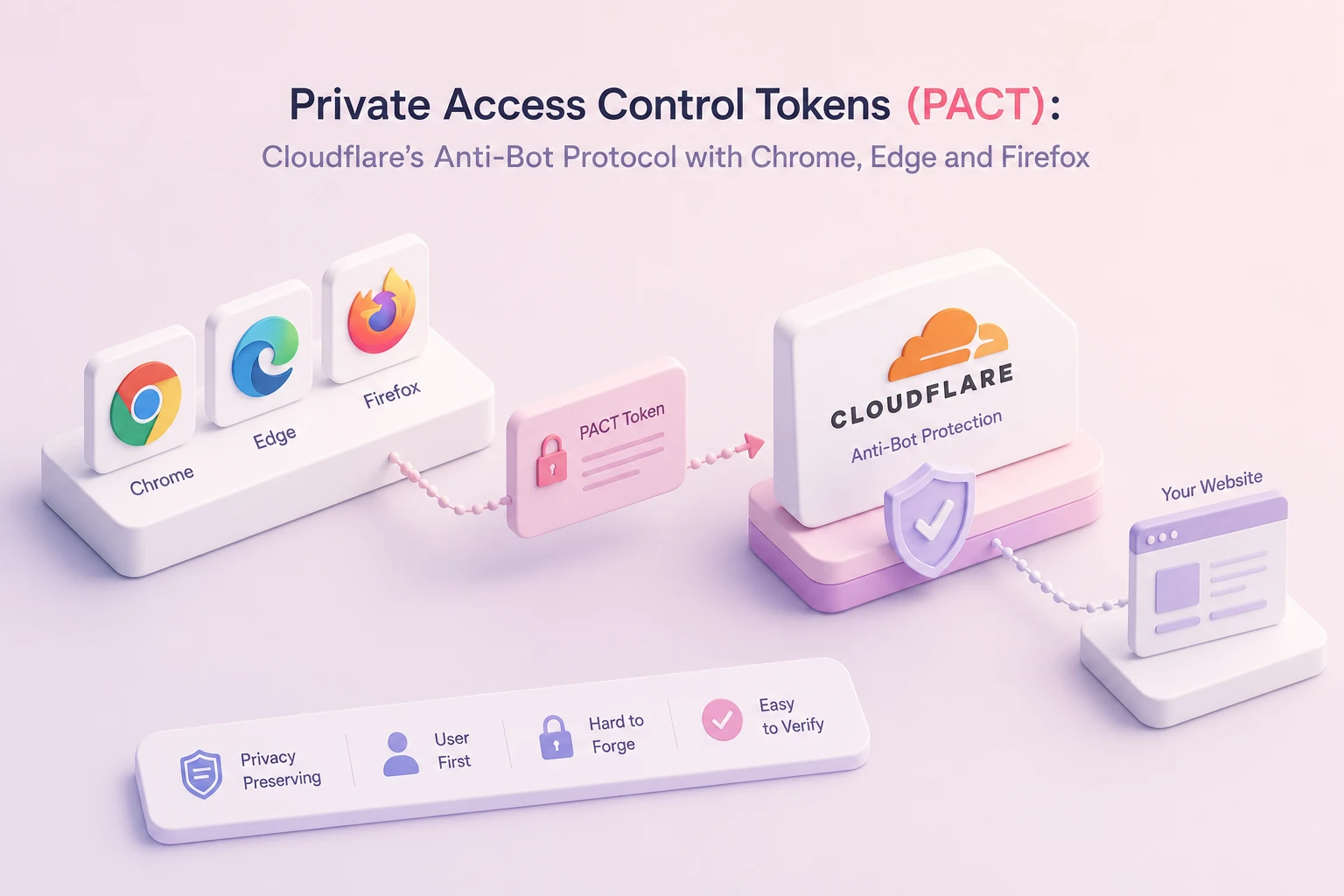
Private Access Control Tokens (PACT): the Privacy Pass successor from Cloudflare, Chrome, Edge and Firefox
Thu, 23 Jul 2026
PoW CAPTCHA Explained: What It Is, and Why It Isn't Enough on Its Own
Wed, 05 Aug 2026
OWASP automated threats: the 21 names your vendor should be using
Tue, 01 Sept 2026