
Why is Ticket Scalping so Hard to Stop? Uncovered
Why ticket scalping is so hard to stop: bots, proxies, bulk accounts and resale markets, the Eras Tour case, and what ticketing platforms can do about it.

Ticketing Updated 3 min read

Ever wondered why ticket scalping is so hard to stop despite countless security measures? Scalpers aren't just resellers - they're part of a multi-billion-dollar underground market exploiting loopholes, high-tech bots, and even organized crime rings.
For the 2025 German Cup final, the DFB reported more than 160 million bot requests against 1.66 million fans trying to buy tickets.
Looking for the practical playbook? See how to stop ticket scalping — the five-layer defence that breaks the scalping economics.
In this article, we will explore:
- Uncover why ticket scalping keeps beating the system
- See how scalping schemes pull off shocking ticket heists
- Stop scalping bots with proof-of-work CAPTCHA technology
The Unsolvable Puzzle: Why Ticket Scalping Continues to Outsmart the System
You've been there. Your favorite artist announces a tour, tickets go on sale at 10:00 AM sharp, and by 10:01 AM, the entire venue is "sold out." Hours later, those same tickets appear on resale sites at triple the price. It's frustrating, it's unfair, and it seems unstoppable.
Why can't we just eliminate ticket scalping? The answer involves a perfect storm of three key factors.
The Digital Arms Race
Modern scalping has evolved far beyond individuals hawking tickets outside venues. Today's scalpers deploy sophisticated technological arsenals that give them an overwhelming advantage:
- Automated bots that purchase tickets in milliseconds, bypassing security measures like CAPTCHA and queue systems
- Networks of fake accounts that circumvent ticket limits (one scalping operation was found using 250 different accounts to purchase 1,000 tickets for a single event)
- Location-masking techniques using proxy servers and VPNs that make tracking and blocking nearly impossible
When one digital door closes, scalpers quickly find another way in. As one former scalper revealed, their operation could submit up to 300 purchase requests per second during high-demand sales.
The Legal Labyrinth
If technology creates the means for scalping, the inconsistent legal landscape provides the opportunity. Scalpers easily exploit the patchwork of regulations that varies dramatically across jurisdictions:
- Scalpers based in regions where reselling is legal can sell tickets to events in places where it's restricted
- Digital transactions routed through multiple countries make it unclear which laws apply
- Enforcement resources are limited and often focused on more serious crimes
- The burden of proof is extremely high, requiring prosecutors to show intent and pattern through extensive digital forensics
This creates a low-risk environment where scalpers can operate in plain sight, often structuring their operations to appear as legitimate secondary market businesses.
The Economics of Incentive
 Perhaps the most fundamental reason scalping persists is simple: it's enormously profitable. The economic incentives create powerful motivation that overcomes most obstacles:
- A $100 face-value ticket for a high-demand event might sell for $300-$500 on secondary markets - a 200-400% profit margin with minimal overhead costs
- Consumers continue to purchase from secondary markets despite knowing they're paying inflated prices, driven by emotional investment and fear of missing out
- Artificial scarcity created when events are priced below market value opens a gap that scalpers readily exploit
A Perfect Storm
The combination of these three factors creates what industry insiders call "the perfect storm for scalping resilience." Each element reinforces the others:
- Technology provides the means to acquire tickets at scale
- Legal gray areas reduce the risk of consequences
- Economic incentives fuel continued innovation in scalping methods
Understanding this triple challenge explains why, despite decades of efforts by venues, artists, ticketing platforms, and legislators, ticket scalping remains a persistent problem that continues to evolve as technology advances and consumer behaviors change.
Scalping Gone Wild: Mind-Boggling Real-World Ticket Heists
Understanding ticket scalping in the abstract is one thing, but seeing its real-world impact through documented cases reveals the true scale and sophistication of modern scalping operations. These aren't isolated incidents - they represent systematic exploitation that affects millions of fans and billions in revenue.
The Taylor Swift Eras Tour Meltdown (2022)
One of the most infamous ticketing disasters in modern history occurred in November 2022 when millions of Taylor Swift fans attempted to purchase tickets for her Eras Tour. The fiasco exposed deep flaws in Ticketmaster's system, reignited debates about monopolistic control, and fueled public outrage against scalpers and bots.
What Happened?
- Over 3.5 million fans pre-registered for Ticketmaster's Verified Fan system, expecting a fair chance at purchasing tickets.
- On November 15, 2022, the presale event launched - and chaos erupted.
- Bots and scalpers flooded the system, causing massive website crashes and hours-long queues.
- By the time the dust settled, 2.4 million tickets had been sold - but a huge portion immediately appeared on resale sites at many times face value.
- The general public sale was canceled entirely, as Ticketmaster declared that there were no tickets left.
The Aftermath & Legal Fallout
- Outraged fans sued Ticketmaster, alleging anti-competitive behavior and failure to prevent bot purchases.
- The U.S. Senate held hearings, questioning Ticketmaster's dominance in the market.
- Taylor Swift herself responded, stating she was "pissed off" and that Ticketmaster had assured her team they could handle demand.
- Financial Impact: Estimates suggest that over $26.4M worth of Eras Tour tickets ended up on secondary markets, further lining the pockets of scalpers.
Key Takeaway: Even the biggest artists struggle to protect their fans from scalping, proving how deeply flawed the ticketing industry is.
FIFA World Cup Scalping – A Global Black Market
The FIFA World Cup is one of the most scalped sporting events in history, with tickets being resold at up to 40 times their face value.
How Scalpers Exploit the System
- FIFA sells tickets through an official lottery system, but scalpers use fake IDs, bots, and international networks to hoard tickets.
- Some organized crime rings have been caught selling fake tickets or using stolen credit cards to make bulk purchases.
- Ticket resale bans in host countries (such as Qatar 2022 and Russia 2018) did little to stop black-market sales.
The Numbers Don't Lie
- 2018 FIFA World Cup (Russia): A single category 4 ticket priced at $105 was resold for over $6,000 on secondary markets.
- 2022 FIFA World Cup (Qatar): Over 800 people were arrested for illegal ticket resales, but scalping continued on digital platforms outside Qatar's legal reach.
Key Takeaway: Even when governments ban resale, the global nature of scalping operations allows them to exploit legal loopholes and profit massively.
Stopping Ticket Scalping with Proof-of-Work CAPTCHA
Ticket scalping has long disrupted the live entertainment industry. Automated bots rapidly purchase large numbers of tickets, leaving genuine fans struggling to secure seats. Traditional CAPTCHA systems have attempted to curb scalping, but many fall short against increasingly sophisticated bots.
However, advancements in Proof-of-Work (PoW) CAPTCHA technology provide a more effective defense.
How Proof-of-Work CAPTCHA Helps Prevent Ticket Scalping
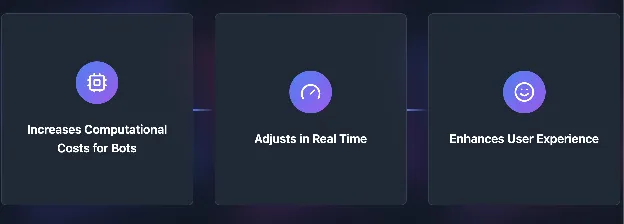
Proof-of-Work CAPTCHA introduces computational challenges that require processing power and time to solve. While negligible for human users, these challenges significantly burden bots attempting mass purchases. Here's how PoW CAPTCHA helps stop scalping:
- Increases Computational Costs for Bots – Every ticket purchase attempt requires solving a PoW challenge. For bots executing thousands of transactions, the accumulated processing demand becomes overwhelming, slowing or blocking automated scalping attempts.
- Adjusts in Real Time – PoW CAPTCHAs dynamically scale challenge difficulty based on traffic patterns. During high-demand sales, these adjustments make it harder for bots to bypass security while ensuring smooth access for genuine buyers.
- Enhances User Experience – Unlike traditional CAPTCHAs that require users to solve puzzles, PoW CAPTCHAs run in the background. Human users experience minimal disruption, while bots face insurmountable barriers.
Stopping scalpers across the whole sale with Prosopo Protect
A CAPTCHA on the checkout form only covers one step. Scalper bots also hammer the queue, the ticket page and the checkout API directly, where no form is ever loaded. Prosopo Protect checks every one of those requests before it reaches your servers.
What that gives a ticketing platform:
- The whole sale covered: the queue, ticket pages, presale codes and checkout API, not just the form. You choose how to integrate: a script tag on your pages, an edge worker on Cloudflare Workers or AWS Lambda@Edge, or both.
- Real fans let straight through: people move through without a puzzle; proof-of-work and challenges are kept for traffic that looks automated.
- A reason for every block: each blocked request names the detector that caught it, so your team can see why a buyer was stopped.
- Published pricing: Enterprise starts at $1,990 a month, priced by the number of sites, with traffic not metered. See the pricing page.
Will Ticket Scalping Ever Be Stopped for Good?
Ticket scalping remains a global challenge, fueled by advanced bots, legal loopholes, and enormous profits. Despite ongoing efforts, scalpers continue to adapt, outpacing security measures and ticketing regulations.
However, technology like Proof-of-Work CAPTCHA offers a powerful defense, making it harder for bots to manipulate sales. While no solution is perfect, stronger digital safeguards, better enforcement, and innovative anti-scalping strategies can help level the playing field for real fans.
Running a ticketing platform?
See how platforms stop scalper bots at the queue, ticket page, drop API and checkout.
Related reading
 CAPTCHA · Which Security Risks Does CAPTCHA Pose: Critical Flaws? Discover the critical flaws in CAPTCHA security that hackers exploit. Learn how to protect your site from threats. Stay secure - read now!
 Ticketing · What do Artists do to Prevent Ticket Scalping? How do artists stop ticket scalpers? See how verified fans, dynamic pricing & blockchain disrupt resale bots and protect fair access.
 CAPTCHA · What is the Future of CAPTCHA and Online Privacy Discover the future of CAPTCHA! Learn how AI, privacy-first authentication & invisible security are shaping online privacy. Stay ahead - read now!
 Privacy · How to make a CAPTCHA GDPR compliant: legal basis, cookie consent and code Seven steps to run a CAPTCHA lawfully under GDPR and the ePrivacy cookie rule: legal basis, privacy policy, cookie consent, data minimisation and code examples.
 Ticketing · How Do Ticket Scalpers Get Tickets? Bots, Tactics & Defenses Ticket scalping meaning, how ticket scalpers get tickets before fans, and the bot tactics behind resale markups — plus what venues can do about it.
 CAPTCHA · How to Integrate CAPTCHA Without Violating User Rights Integrate CAPTCHA the right way! Ensure security, privacy, and accessibility without violating user rights. Follow our expert guide for best practices!