
What is account takeover (ATO)? How the fraud works
Account takeover is a criminal logging in as your customer. Bot management stops the automated routes in, like credential stuffing, but phishing needs MFA.

9 min read
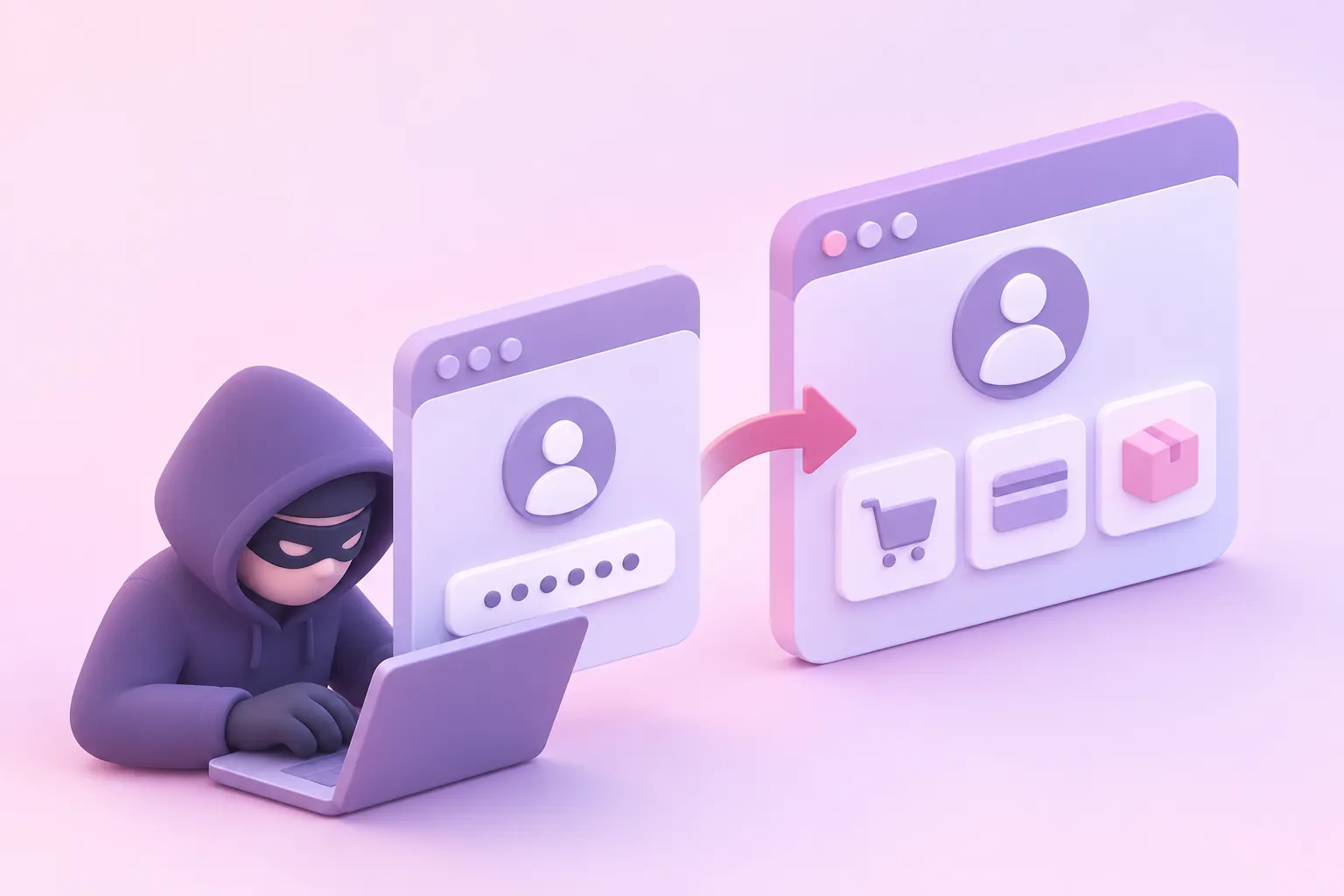
Account takeover, usually shortened to ATO, is when someone other than the owner gets into an online account and uses it as if they were the owner. The break-in is the takeover, and ATO fraud is what follows: a saved card spent, a balance moved, loyalty points redeemed or the account itself sold.
The FBI's Internet Crime Complaint Center issued a public service announcement on 25 November 2025 saying it had received "more than 5,100 complaints reporting ATO fraud, with losses exceeding $262 million" since January 2025, from one scheme in which criminals pose as bank support staff. That figure only counts complaints to the FBI about that scheme, so it is a floor rather than a total.
This article covers how attackers get in, what they do once inside, the signals that show it happening, and whether bot management can stop it. If you already know the background and want to stop it on your own login, see account takeover prevention.
Five routes into an account
1. Credential stuffing. Bots replay username and password pairs leaked in other sites' breaches against your login, counting on people reusing passwords. It is the route that produces takeovers in bulk: Roku disclosed about 576,000 accounts taken this way in a single incident in 2024. The full explanation is in what is credential stuffing. Password spraying, which tries a few common passwords against many accounts, is its close relative.
2. Phishing. The customer is tricked into typing their login details into a fake page. The FBI notice above describes criminals contacting victims by text, call or email, claiming fraud on the account, and sending them to a phishing site or a fake login page bought as a search ad, where they are tricked into giving away "their login credentials, including multi-factor authentication (MFA) code or One-Time Passcode (OTP)". A one-time code read out or typed into the attacker's page is as good as the real thing for the few minutes it lasts.
3. SIM swap. The attacker persuades the victim's mobile carrier to move their number to a SIM the attacker holds, then receives every SMS code sent to that number. In the US, the FCC adopted rules in November 2023 requiring carriers to authenticate customers before a SIM change or port-out and to notify them when one is requested.
4. Session or cookie theft. Once someone has logged in, the site trusts a session cookie rather than asking for the password again. Malware on the victim's computer that copies that cookie lets the attacker skip the login, and the MFA check with it, until the session expires.
5. Password reset and account recovery abuse. Reset and recovery flows often accept less proof than the login: access to the email inbox, a code by SMS, or answers to security questions. An attacker who controls the inbox or the phone number, or who can guess the answers, resets the password and takes the account. Bots also hammer reset endpoints to find which email addresses have accounts.
What attackers do after a takeover
Spend stored payment methods. In the Roku incident, attackers used saved payment methods in fewer than 400 of the 576,000 accounts to buy subscriptions and hardware, according to BleepingComputer.
Drain stored value and loyalty points. Balances, points and gift cards are attractive because they can be spent or transferred without a card check. The New York Attorney General's 2020 settlement with Dunkin' concerned credential stuffing against accounts holding stored-value cards, and required Dunkin' to refund stolen funds. Points farming and fake-account abuse of the same programmes is covered in loyalty programme automation.
Sell the account. Working logins are a product in their own right. BleepingComputer reported compromised Roku accounts being sold for as little as 50 cents.
Take the data. Some accounts are valuable for what they can see rather than what they can spend. Through about 14,000 accounts taken over by credential stuffing, the attacker in the 2023 23andMe incident reached profile data on about 6.9 million people who shared data with those accounts.
Lock the owner out. Changing the email, phone number and password keeps the real owner from recovering the account or noticing the theft until it is too late. The FBI notice describes attackers resetting the password and then wiring funds to accounts, "many of which are linked to cryptocurrency wallets".
Account takeover signals at login and after
Takeover shows up in two places, and each needs watching separately.
At login:
- The ratio of failed to successful logins rises across the site, even if no single IP address crosses a limit.
- Logins arrive through residential proxies, datacentre networks or VPNs that your real customers rarely use.
- One device or connection logs in to many different accounts.
- Logins for accounts that have been dormant for months appear in a burst.
- The same account is reached from two distant places in a short time.
After login:
- Email, phone number or password changes soon after a login from a new device.
- A new delivery address, followed by an order paid with a saved card.
- Points, gift card balances or stored value redeemed or transferred all at once.
- Account recovery or password reset requests for many accounts from the same source.
Bot management stops the automated routes, not phishing or SIM swap
The question "can bot management stop account takeover?" has a two-part answer.
Bot management stops the automated routes in. Credential stuffing and password spraying only pay off at scale, so they depend on sending large numbers of login attempts, and stopping that automation at the login, the auth API, password reset and account recovery removes the routes that produce takeovers in bulk. It also cuts off account-checker tools that sort a combo list into working and failed logins, and automated probing of reset forms to find which emails have accounts.
Bot management does not stop the attacks that target one person:
- a customer phished into typing their password and one-time code into a fake site, then a person logging in with them
- a SIM swap at the customer's mobile carrier, which lets the attacker receive SMS codes legitimately
- malware on the customer's own computer stealing a session cookie
For those, the defences are phishing-resistant authentication such as passkeys, which will not sign in to a look-alike domain; avoiding SMS as the only second factor; and checks after login, such as notifying the owner of every change to contact or payment details and asking for re-authentication before high-value actions.
The useful signals for stopping the automated attacks are network and connection based, because takeover tools run through residential proxies and anti-detect browsers that report whatever browser details the operator chooses. IP reputation, whether the connection comes through a proxy, the TLS fingerprint of the client and how the visitor interacts with the page are much harder to fake than what the browser claims about itself.
Account takeover checklist
- Offer MFA, and prefer passkeys. See multi-factor authentication for the options. Roku and 23andMe both turned on two-factor authentication for all users after their incidents.
- Check new passwords against breach lists, as NIST SP 800-63B requires of verifiers.
- Rate-limit by account, device and network, not only by IP address, so attempts spread across a proxy pool still add up.
- Detect bots on every way in: login form, auth API, password reset and account recovery, not only the login page.
- Notify the owner of every change to email, phone, password or payment details, using the old contact details as well as the new ones.
- Add a check before high-value actions on a session that has just changed contact details or logged in from a new device, such as redeeming points, adding a delivery address or transferring a balance.
- Monitor the login success ratio and alert when it shifts.
- Make recovery as strong as login. A reset flow that asks for less than the login is the easier way in.
How Prosopo fits
Prosopo covers step 4. It checks each request to login, password reset and account recovery, and blocks the automation before a password is checked, while real users and password managers pass without a challenge. Prosopo Protect does this at your edge on Cloudflare Workers or AWS Lambda@Edge, so it also covers auth APIs that never load a form, and its residential proxy detection checks the TCP connection against the device the browser claims to be. Every block names the reason it fired, so your fraud team can see why a login was stopped.
Seeing takeovers you cannot explain?
A Bot Exposure Assessment is a 30-minute call with an engineer. We look at your traffic, show where your current setup leaves gaps, and agree how a trial would be judged. Nothing to install first.
Questions
Something else? Ask an engineer.
What is account takeover?
Account takeover (ATO) is when someone other than the owner gets into an online account and uses it as if they were the owner. The attacker usually gets in with a stolen or guessed password, a phished login and one-time code, a hijacked phone number or a stolen session cookie, and then changes the email or password so the real owner is locked out.
What is account takeover fraud?
Account takeover fraud is the money-making step after the break-in: spending a saved card, moving a balance, redeeming loyalty points or gift cards, or selling the account on. The FBI's Internet Crime Complaint Center said in November 2025 that it had received more than 5,100 complaints of ATO fraud since January 2025, with losses over $262 million, in a scheme where criminals impersonate bank support staff.
Can bot management stop account takeover?
It stops the automated routes in, which are the ones that work at scale: credential stuffing, password spraying and account-checker tools, plus automated abuse of password reset. It does not stop a single customer being phished into typing their password and one-time code into a fake site, a SIM swap at their mobile carrier, or malware stealing their session cookie. Those need MFA that resists phishing, such as passkeys, and checks on what happens after login.
What is the best bot protection for account takeover attacks?
Protection that covers every way into an account rather than only the login page: the login form, the auth API used by mobile apps, password reset and account recovery. It should judge the network and connection as well as the browser, because takeover tools run through residential proxies and anti-detect browsers, and it should tell your fraud team why each request was blocked.
How do you detect account takeover?
Watch both the login and what follows it. At login, look for a rising share of failed attempts, logins from proxy networks, and many accounts accessed from one device or connection. After login, look for a changed email, phone or password soon after a new device appears, a new delivery address, a stored card used for an unusual purchase, and loyalty points or balances drained.
How do you prevent account takeover?
Offer MFA or passkeys, check passwords against breach lists, rate-limit by account and device as well as IP, detect bots on login, password reset and account recovery, notify the owner of every change to email, phone, password or payment details, and add a delay or step-up check before high-value actions on a session that has just changed those details.
Related reading
 Technical · Faking browsers is easy — but not at scale 131,819 residential US IPs threw 1.4M brute-force attempts at one mobile-only customer in 30 days — all collapsing onto a handful of fingerprints.
 What is credential stuffing? How it works and how to stop it Credential stuffing is bots replaying passwords leaked from one site against the login of another. How attacks run, real incidents, and the defences.
 OWASP automated threats: the 21 names your vendor should be using The OWASP Automated Threat Handbook gives every bot attack a vendor-neutral name and an OAT number. The full taxonomy, the five that cost the most money, and how to use it in an RFP.
 OWASP API Security Top 10: which two a bot layer actually fixes Eight of the ten risks in the 2023 OWASP API Security Top 10 are authorization and inventory bugs only your own code can fix. API4 and API6 are the two where a bot-protection layer is the right tool.