
Why Am I Clicking Traffic Lights? The reCAPTCHA CAPTCHA Explained
Traffic lights, cars and crosswalks in reCAPTCHA are not random — you've been labelling training data for Google's computer-vision models for a decade. Here's how the traffic-light CAPTCHA works, why it's still shown, and what a modern alternative looks like.

CAPTCHA Updated 5 min read
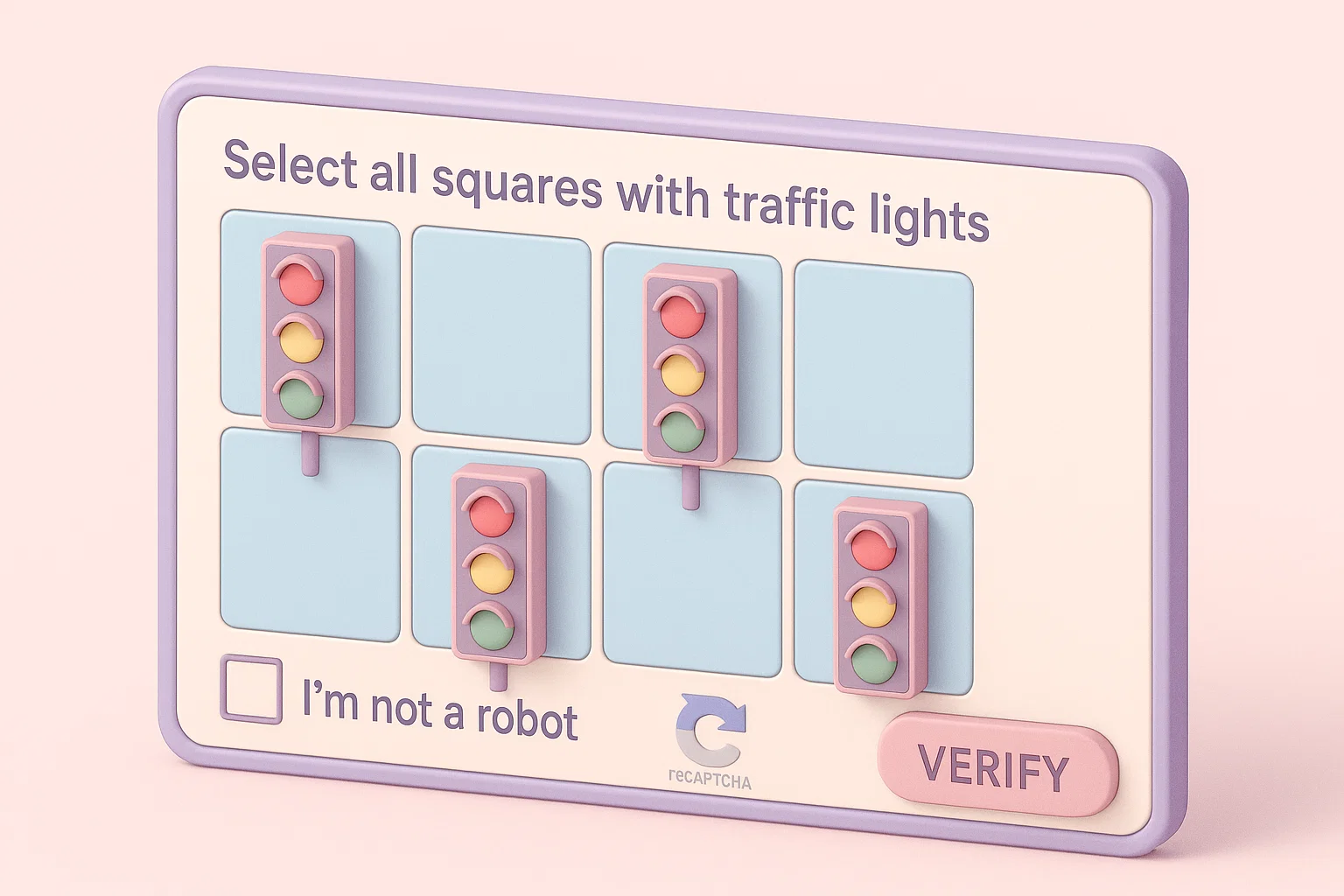
The use of images of traffic lights, cars, crosswalks, and other urban scenery in reCAPTCHA challenges is an interesting intersection of human-computer interaction, machine learning, and the evolving needs of digital security. This article explains the reasons behind this specific choice of images, exploring its implications for both security and the development of artificial intelligence.
Origins of reCAPTCHA
reCAPTCHA is a service from Google that attempts to help protect websites from spam and abuse. Initially, it was developed to both improve the process of digitizing text from books and newspapers and provide security for online services. Users were asked to type words that computer algorithms had trouble recognizing. This method not only improved the digitization of texts but also served as a test to distinguish between human users and automated bots, though provided a poor UX.
Transition to Image-based CAPTCHAs
As machine learning and optical character recognition (OCR) technologies advanced, the effectiveness of text-based CAPTCHAs diminished. Bots became increasingly proficient at deciphering distorted text, prompting the need for a more reliable method to prevent automated abuse. Consequently, reCAPTCHA evolved to include image-based tests, which required users to identify and select images matching a specific prompt, such as traffic lights, cars, or storefronts.
Unfortunately, along with more difficult CAPTCHAs came an even worse user experience than before.
What is the traffic light CAPTCHA?
The "traffic light captcha" is Google's image-based reCAPTCHA v2 challenge, in which a user is asked to select all images with traffic lights (or crosswalks, buses, cars, bicycles, fire hydrants, etc.) from a 3×3 or 4×4 grid. It appears when reCAPTCHA's silent risk score cannot confirm a session is human. The captcha traffic lights challenge remains one of the most frequently served image tasks because urban scenery is both familiar to a broad global audience and usefully ambiguous for computer-vision models.
Why does the CAPTCHA ask me to select all images with traffic lights?
Two overlapping reasons:
- Adversarial difficulty for machines. Traffic lights are partially occluded, cropped, and shot at odd angles — exactly the cases where CNN-based image classifiers still stumble.
- Data collection for AI training. Every user who solves a traffic-lights challenge labels image data at scale. Google has publicly denied using this to train self-driving cars, but the data is unquestionably valuable for that class of model.
The captcha traffic lights image set also gets rotated periodically as machine-learning models catch up — which is why the puzzles have become visually harder over the last few years.
Why Traffic Lights, Cars, and Urban Scenery?
The choice of traffic lights, cars, and urban scenery for reCAPTCHA challenges is not arbitrary. It is grounded in several practical and technological considerations:
Complexity for Machines
These images often contain complex patterns that are challenging for AI to interpret accurately. Despite significant advancements in machine learning, the ability of AI to understand context and make nuanced distinctions in cluttered or overlapping images remains limited compared to human perception.
Further complexity is the source of the particularly odd looking more recent CAPTCHAs.
Familiarity
Traffic-related objects are mostly familiar to most people around the world, regardless of their country. This universality is crucial for ensuring that reCAPTCHA tests are accessible and solvable by a wide demographic of users.
With this said, there are concerns that too high a focus on imagery and data from the USA can easily lead to a poor UX for other countries.
Contribution to AI Training
By asking millions of users to identify these objects in images, Google can use the aggregated data to train machine learning models. This is particularly useful for improving AI in areas such as autonomous driving technologies, where the ability to accurately recognize traffic-related objects is paramount.
Google denies using this data to train autonomous driving cars, however this would hardly be the first time the tech giant lied.
Security and Beyond
The primary goal of using such images in reCAPTCHA challenges is to verify that the user is indeed human. However, the implications extend far beyond simple security measures. By using human cognition to identify specific items within images, Google can continuously enhance its AI closed-source algorithms, particularly for projects related to image recognition and autonomous vehicles.
Whether this has a positive effect on the wider AI community is up for debate, though few would argue that a data monopoly benefits anybody.
Ethical and Privacy Considerations
While the use of reCAPTCHA challenges serves important purposes in security and AI development, it also raises questions about privacy and the use of human labour in machine learning. Google states that it uses data from these challenges to improve its services and technology, but the process also underscores the vast amount of data collected and its potential uses.
Vast data collection always leads to the inevitability that personal data is both included and leaked.
What does all this mean for me?
The use of images of traffic lights, cars, and urban scenery in reCAPTCHA challenges is a multifaceted strategy that addresses the twin goals of enhancing digital security and advancing machine learning technology. It exemplifies how human-machine interactions can be designed to mutual benefit, albeit not without raising questions about privacy and the ethical use of data. As technology continues to evolve, so too will the methods and rationale behind these ubiquitous tests, as the cat-and-mouse game between security experts and attackers continues.
You've probably noticed by now you're on a website with a reCAPTCHA alternative. Prosopo Procaptcha is an invisible CAPTCHA — real users pass silently on the strength of behavioural analysis, device fingerprinting and proof-of-work, and only suspected bots ever see a challenge. For the wider comparison across every mainstream CAPTCHA in 2026, see the best CAPTCHA guide. For the enterprise-scale bot-protection view — DataDome, Kasada, HUMAN and the rest of the Forrester Wave Q2 2026 vendors — see the Prosopo Bot Protection product page.
Stop Clicking on Traffic Lights
A Bot Exposure Assessment is a 30-minute call with an engineer. We look at your traffic, show where your current setup leaves gaps, and agree how a trial would be judged. Nothing to install first.
Questions
Something else? Ask an engineer.
Why does reCAPTCHA show traffic lights?
reCAPTCHA shows traffic lights (along with crosswalks, cars, buses and bicycles) because they are objects that were historically hard for computer-vision models to reliably identify at odd angles, in partial occlusion or in variable lighting — exactly the cases where a real human would still succeed. Every solved challenge also labels image data that is useful for training the same class of models.
What is the traffic-light CAPTCHA?
The traffic-light CAPTCHA is Google reCAPTCHA v2's image-grid challenge, in which a user is asked to select all images with traffic lights (or crosswalks, buses, cars, bicycles, fire hydrants and similar urban scenery) from a 3×3 or 4×4 grid. It appears when reCAPTCHA's silent risk score cannot confirm a session is human.
Does Google use traffic-light CAPTCHA solutions to train self-driving cars?
Google has publicly denied using reCAPTCHA-labelled data specifically to train autonomous vehicles. What is undisputed is that the labelled data is useful for the same class of computer-vision model, and that reCAPTCHA's earlier text-based version was openly used to digitise books and Google Street View house numbers. The distinction between 'usable for autonomous driving' and 'used for autonomous driving' is doing a lot of work in Google's public statements.
Why are traffic-light CAPTCHAs getting harder?
The images are periodically rotated as computer-vision models catch up. When AI can solve the current puzzle set reliably, Google raises difficulty — more occlusion, tighter crops, ambiguous edge cases — so the challenge continues to be adversarial. The side-effect is that legitimate users find the puzzles harder too, and the modern traffic-light CAPTCHA is often multi-page and slow to load as a result.
Can AI solve the traffic-light CAPTCHA?
Yes. Vision-language models released in 2024 and later solve reCAPTCHA v2 image grids with higher accuracy than the average human, and commercial CAPTCHA-solving farms clear the challenges at roughly $1 to $2 per 1,000 tokens using distributed human-plus-model pipelines. The traffic-light CAPTCHA is now an obstacle for users but not for a determined attacker.
What is a good alternative to the traffic-light CAPTCHA?
The modern replacements are invisible-first CAPTCHAs that only escalate to a challenge when a session looks suspicious. Prosopo Procaptcha uses proof-of-work, behavioural analysis and device fingerprinting as silent layers, so real users see nothing and never click a traffic light. Cloudflare Turnstile, Friendly Captcha and ALTCHA are the other main invisible-first options, though each makes different trade-offs on catch rate and GDPR posture.
Related reading
 CAPTCHA · What is the best value CAPTCHA in 2024? Find out what the best value CAPTCHA is in 2024 and how it compares to other popular CAPTCHA solutions.
  Ticketing · How Do Ticket Scalpers Get Tickets? Bots, Tactics & Defenses Ticket scalping meaning, how ticket scalpers get tickets before fans, and the bot tactics behind resale markups — plus what venues can do about it.
  CAPTCHA · hCaptcha and GDPR - Privacy Claims Warrant Scrutiny Examination of hCaptcha reveals several potential friction points with GDPR principles.
  CAPTCHA · Best CAPTCHA 2026: 7 Top Solutions Compared What is the best CAPTCHA in 2026? Compare pricing, privacy, GDPR compliance and bot-stopping power across the 7 leading CAPTCHA solutions.
  CAPTCHA · PoW CAPTCHA Explained: What It Is, and Why It Isn't Enough on Its Own Proof-of-work CAPTCHA explained — how the hash-puzzle mechanism works, why it went mainstream after reCAPTCHA's price hike, and what it still can't stop on its own.
  CAPTCHA · Invisible Captcha: A Silent Solution by Prosopo Invisible captcha blocks spam and abuse without a challenge screen — how Procaptcha runs silently in the background and only interrupts suspicious traffic.